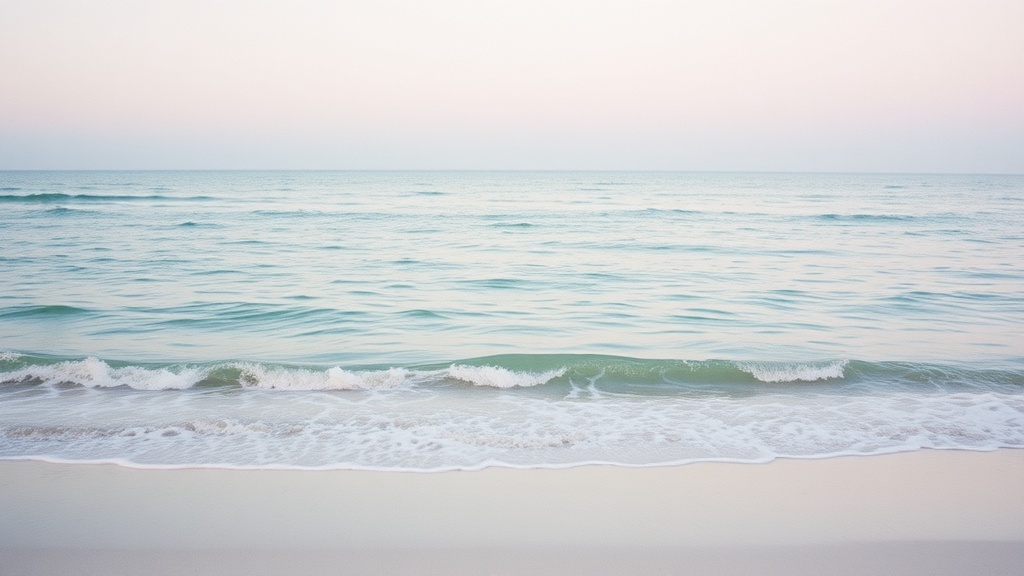
Ocean Wellness for Women: The Self-Care Practices That Actually Work (From Someone Who Lives on the Water)

March 8 is International Women's Day, and every year around this time my inbox fills up with the same content: bubble bath roundups, "treat yourself" listicles, and spa gift guides that cost more than my first car.
I get it. Self-care content sells. But I want to talk about something different — something I've actually seen work, for me and for the women I've met at beaches across 12 countries.
The ocean doesn't care about your productivity metrics. It doesn't respond to your mood. It just does its thing. And for a lot of women, that's exactly what they need.
Why the Ocean Keeps Coming Up in Wellness Research
This isn't new-age stuff. There's a growing body of research around what scientists call "blue space" — the idea that proximity to water (oceans, lakes, rivers) is associated with reduced stress and improved mental wellbeing. Researchers at the European Centre for Environment and Human Health at the University of Exeter have published multiple studies in this area, with findings suggesting that people who spend time in coastal environments tend to report better mental health outcomes — though the researchers are careful to note that it's hard to fully separate those effects from confounding factors like physical activity and general time outdoors.
I didn't need a study to tell me this. I grew up within earshot of the Atlantic in Jacksonville. The ocean was where my family went when things got heavy. Dad got back from deployment — beach. My mom had a rough week teaching — beach. Report card came out and it was either great or terrible — beach, either way.
The ritual of going to water is ancient. It's cross-cultural. And it works.
What "Ocean Wellness" Actually Looks Like (Not the Instagram Version)
When I worked the guest experience desk at a boutique resort in Tulum, I saw two kinds of guests. The ones who showed up chasing what they'd seen on social media — the perfect turquoise photo, the cenote content, the aesthetic — and the ones who actually came to decompress.
The second group always had a better time. Every single time.
Here's what I saw the happiest, most-recharged women actually doing:
1. Getting in the water with no agenda
Not snorkeling for the Gram. Not swimming a set distance. Just getting in and floating. Salt water does something to your body — the buoyancy is real, and the combined sensory input of temperature, movement, and sound is legitimately grounding in a way that's hard to replicate on land.
If you're near a beach, this is free. You don't need a class, a retreat, or a subscription. Get in the water and float on your back until your brain goes quiet. That's it. If you're looking for great places to actually do this, the best beaches for March offer solid options with manageable crowds.
2. Morning beach walks before anyone else is up
I do this at home in St. Augustine when the season isn't too crowded. There is something specifically powerful about being at the ocean before the day officially starts — before your phone fills up, before anyone needs anything from you.
The light is different. The sound is different. The beach belongs to you in a way it won't at noon.
This is one of those things that sounds too simple until you do it at 6:45 AM on a morning when you have a lot on your mind and you come back feeling like an actual human again. Sanibel Island in March has this exact quality — it's the kind of place where those early mornings actually hit different.
3. Cold water exposure (intentionally)
I know cold plunges are everywhere right now, and the research is genuinely interesting — though the mechanisms are still being studied and the marketing tends to run well ahead of the evidence. What we do know: cold water immersion triggers an acute stress response, and many people report a marked sense of calm afterward. Researchers have pointed to vagal nerve activity and parasympathetic rebound as possible explanations, but this is an active area of research, not settled science.
What I can tell you from personal experience: getting into cool ocean water in early spring off the northeast Florida coast — the Atlantic around St. Augustine and Jacksonville runs roughly 60–65°F in March, though temperatures vary significantly as you move south toward Miami — is bracing in a way that genuinely snaps you out of whatever loop you were running. You don't need a cryo-chamber. Walk in past your knees and you'll feel it.
4. Sitting with the sound, not through it
Here's one that takes practice: go to the ocean and don't put headphones in. Don't call anyone. Don't scroll while you're there.
Just listen.
Research has looked at whether rhythmic, low-frequency sounds like ocean waves can promote more relaxed brain states — the findings are promising but still preliminary. What I know from experience is this: sitting with only wave sound forces your brain to stop multitasking. No input means no processing queue. That alone is worth something.
My mom does this every time she visits. She's been an elementary school teacher for 28 years. She says fifteen minutes of sitting with just the ocean is worth three hours of sleep. I believe her.
5. Watching the horizon line (it literally fixes your eyes)
This is a small one but it's real. Your eye muscles are almost always in close-focus mode — screens, books, faces. The ocean gives you the only near-infinite focal plane you'll get in daily life. Looking at the horizon, letting your eyes relax all the way open, is a genuine physical relief.
Ophthalmologists recommend this for eye strain. It also just feels like a reset in a way that's hard to explain until you've done it after a week of staring at a laptop.
What to Do If You're Landlocked
Most of the women reading this aren't in St. Augustine. So here's how to approximate this:
Find your nearest blue space. Lake, river, reservoir — whatever you've got. The research shows it doesn't have to be the ocean specifically. Water works. If you're in a seasonal area and can swing a weekend trip, even spring break alternatives that cost half the price can give you that reset you need — and they're usually less crowded than peak-season beaches.
Use the sounds with intention. High-quality ocean sound recordings (not the tinny loops on sleep apps) are worth trying — I like ones that have wind and some distant texture in the mix. The research on audio-only blue space is limited, but it's a low-cost experiment.
Cold water at home. A cold-ending shower — the last 30–60 seconds running cold — is a reasonable approximation in terms of the jolt and pattern interrupt. It's not equivalent to ocean immersion, but it's something, and it's free.
Find still water in the morning. A park with a pond or a lake at 6:30 AM has that same quality of light and quiet as a beach morning. The principle is the same: get near water before the day starts.
The Honest Truth About Wellness Trends
International Women's Day has become, for a lot of brands, another excuse to sell things. I'm not against that — buying something you love because it's on sale is fine, you don't need a philosophy about it.
But I think the most meaningful thing we can do for ourselves and the women in our lives isn't to consume more self-care products. It's to actually stop. To find water. To let our nervous systems do what they're trying to do.
My mom didn't have a wellness budget when we were kids. She had the beach ten minutes away and the sense to use it. She still calls it the best therapy she's ever had.
I think she's right.
One Practical Thing to Do This Week
If you're within an hour of any body of water, I want you to block two hours on your calendar before International Women's Day on March 8. Go to the water. Don't plan what you'll do there. Bring a towel and a water bottle. That's it.
If you're not near water, find a park near something that moves — a creek, a fountain, a lake. Set your phone face-down. Sit for 20 minutes.
That's the practice. It's not complicated and it doesn't cost anything.
You've got this. Go find some water.
Kayla Nakamura has been to 38 beaches across 12 countries and spent 2 years working resort guest experience in Tulum. She writes about beaches, travel, and what actually makes ocean trips worth it — from St. Augustine, FL, where she lives with her fiancé Darius, her golden retriever Sandy, and an embarrassing number of flip-flops.